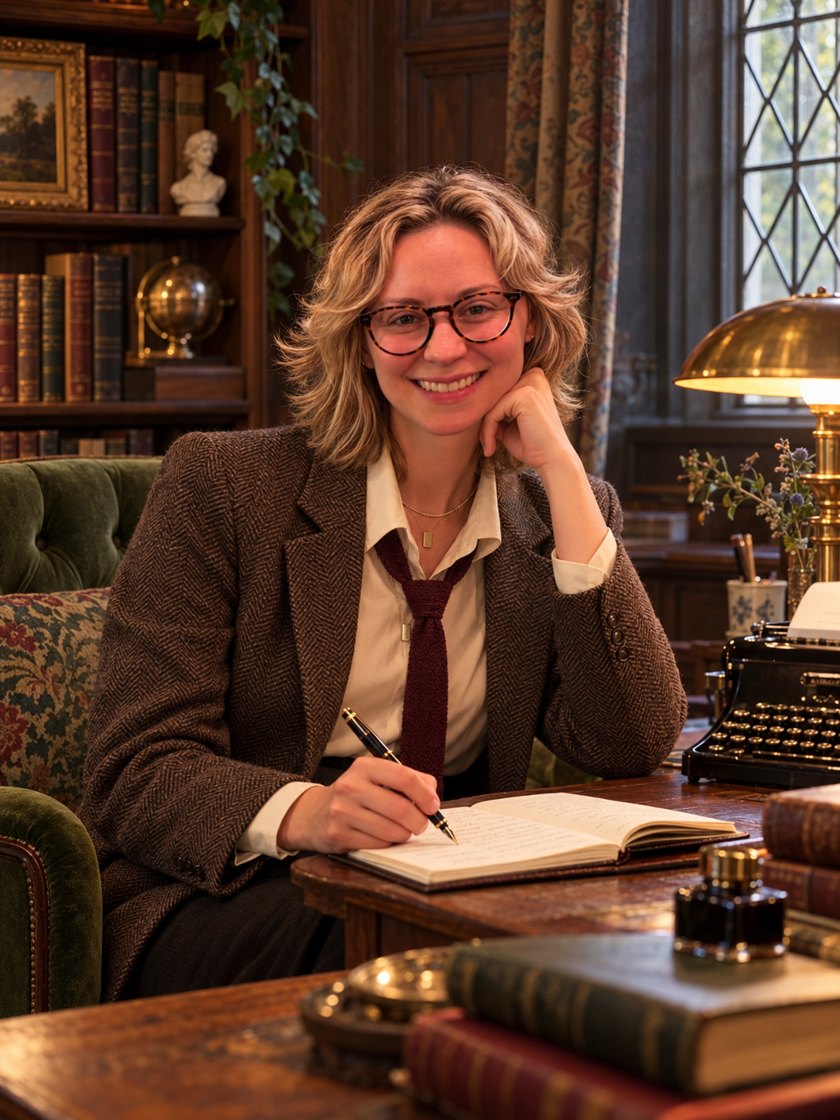
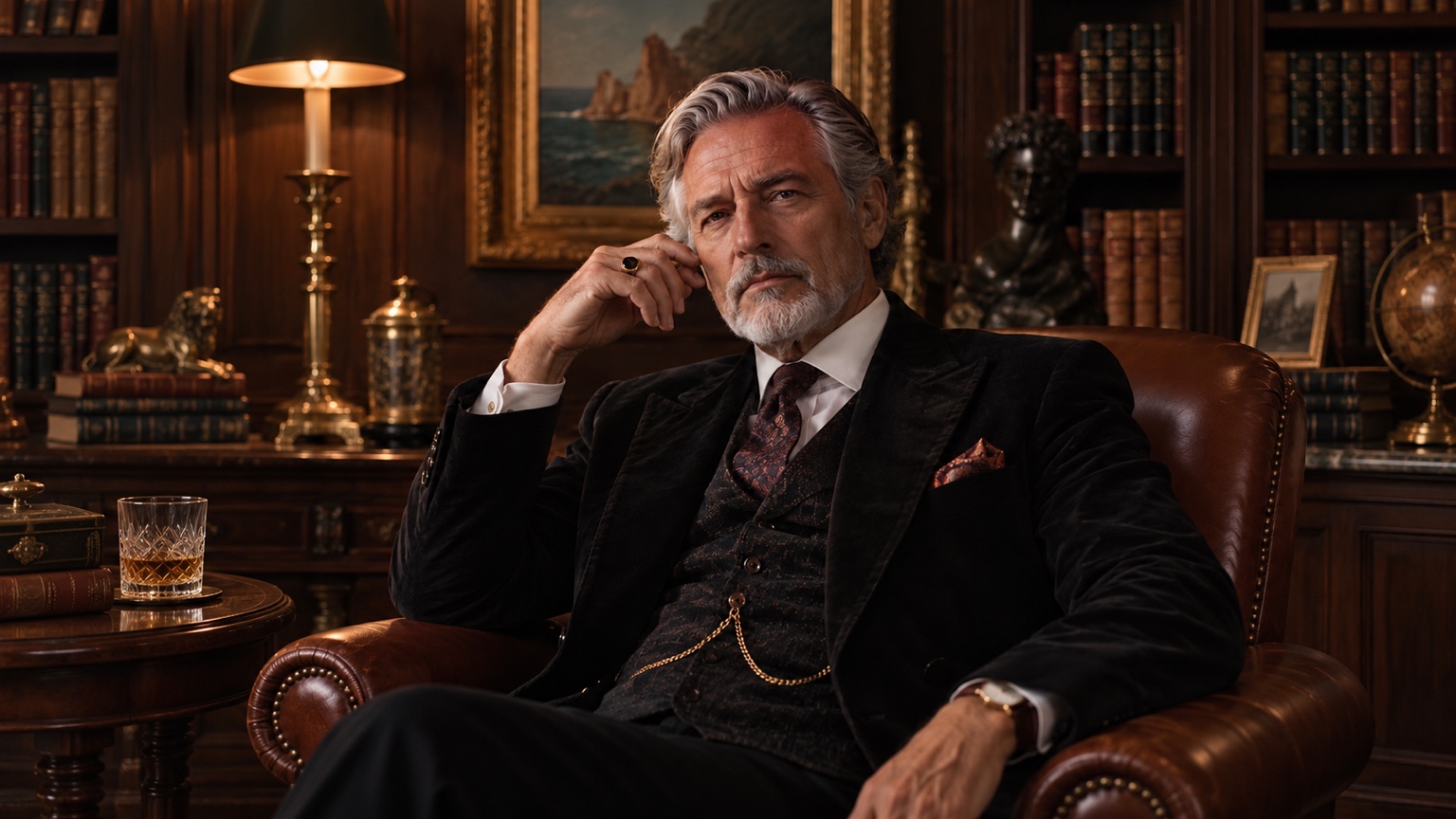
The first mistake was assuming the dead man had finished talking.
Augustus Blackwood had summoned us to his manor for the reading of his will. A modest occasion, by the standards of a man who considered an archaeological discovery a personal shopping opportunity. Family. Associates. Old acquaintances with excellent tailoring and the shared instinct to look elsewhere when Morocco came up.
I had brought a notebook. Several people had brought secrets. We were all, in our different ways, hoping to leave with something valuable.
By the end of the evening, a woman would acquire a father, a man would recover his name, and a murderer would discover that the most dangerous thing in a room full of suspicious people is a sentence nobody thinks to forget.
But first there was the will.
01 / THE GATHERING
A very well-dressed collection of reasons.
Blackwood Manor wore its wealth comfortably. Wood, leather, the accumulated confidence of expensive objects. In such surroundings, even a perfectly ordinary pause can appear to have been inherited.
Lord Percival and Madame Seraphina arrived first, ahead of schedule. Punctuality at a will reading is not a crime, although it does suggest an encouraging interest in the outcome. Percival questioned my connection to Augustus before explaining his own: a London pub, sometime in the 1990s. A surprisingly ordinary beginning for a friendship that had apparently become so expensive.
At six, Alfred began receiving the rest of the company with impeccable manners and an expression that volunteered nothing. Dr. Evelyn Ashcroft and Captain Jack Mercer arrived with pimento dip and implements allegedly intended for archaeological excavation. It was an unusually broad interpretation of what to bring to dinner. Evelyn spoke of gold coins discovered in Portugal. Of Morocco, where her brother Henry had supposedly died on Augustus’s expedition, she initially said rather less. I noticed the geography.
Henri Beaumont did not so much enter as announce an entirely new standard for entering. His hair was ambitious. His jacket refused to be outdone. Beneath the flamboyance was an antiquities dealer whose own history remained considerably harder to inspect than his wardrobe. A man who gives you that much to look at may still be deciding what you are allowed to see.
Maximilian Roth offered a different performance: few words, carefully rationed, from a man who seemed to regard conversation as an unsecured loan. He maintained that he was there because he had been invited. Charles Blackwood, Augustus’s publicly acknowledged son, appeared altogether more cheerful. I would not convict a man for failing to look bereaved. I would, however, make a note beside the inheritance. I did.
Celeste Saint Claire brought the assurance of a movie star who knew precisely what an audience was for. Colonel Sebastian Drake maintained a military bearing and a more selective approach to conversation. Vivienne, Augustus’s ex-wife, arrived elegant and composed, with the unmistakable air of a woman accustomed to a particular standard of living. The will would shortly test the dimensions of that standard.
Closer to the household stood Colette, the maid; Dr. Theodore Graves, Augustus’s physician; and Beatrice Sinclair, his chief of staff. Beatrice seemed entirely at ease. Years spent managing a powerful man’s affairs will do that. They will also put a remarkable amount of information within reach.
During the early conversation, Beatrice made a remark I put into my notebook without yet knowing what to do with it.
“Surely the cognac had nothing to do with it.”
A curious observation. But people say curious things around a death. Especially when the dead man has been paying their salaries.
Then Alexander Sterling, Blackwood’s executor, brought the room to attention.
“Augustus Blackwood was many things. Patient was not among them.”
At last, a statement nobody needed to contest.
02 / THE WILL
The maid’s name was in it.
The early bequests established that death had done nothing to improve Augustus’s manners. Colonel Drake received a compass accompanied by a criticism of his navigation. Captain Mercer inherited the expedition journals, except the Morocco journal, which would remain sealed. Percival received nothing of monetary value. He had, Augustus explained, cost quite enough already.
Seraphina was left occult texts, with the suggestion that she return them personally if her professional claims held up. Celeste received ten thousand dollars to settle a Monte Carlo debt Augustus still considered excessive. Vivienne, his ex-wife, received the Palm Beach house, jewelry, and the satisfaction of having outlasted the first two. Charles received the investment portfolio. Roth, two hundred and fifty thousand dollars. Even death had not persuaded Augustus to stop keeping accounts.
Vivienne’s response to Palm Beach deserved its own entry. The house, she complained, was too small. Here was a woman contemplating bereavement and finding the floor plan inadequate. Grief comes in many forms. Some are measured in tears. Others in oceanfront real estate.
A final testament, apparently, could double as an exceptionally expensive complaints column.
Then the tone changed.
“To Colette, I leave the Blackwood Family Trust and a sealed, personal letter.”
“Colette Blackwood is my daughter.”
The room knew a Colette. It did not know it had been standing beside another Blackwood.
The maid was Augustus’s daughter.
Charles had arrived as the presumed heir and only publicly acknowledged child. Before we had even reached the suspicious circumstances, the family tree had developed an unexpected extension. Colette had spent years inside the household. Now the household had to reconsider what inside meant.
For a moment, I thought that would be the story: a secret daughter, a displaced expectation, a fortune turning a corner.
Then Augustus directed that the sealed papers concerning the 1998 expedition be opened in the presence of every person named in the will.
“Some things, however, refuse to stay buried.”
Sterling had a letter. At Blackwood’s instruction, samples had been retained for independent examination. The physician’s tidy explanation—a heart attack—was about to encounter an untidy fact.
“Augustus Blackwood did not die of natural causes.”
The finding identified a lethal foreign compound, BX-17. Poison.
We had assembled to divide the estate. Someone among us had helped make it available.
03 / THE JOURNAL
Morocco was never finished.
Inheritance supplies motives in bulk. I have never found that it supplies answers quite so generously. To understand Augustus’s death, we needed to understand what he had been afraid of while alive.
Seraphina had already offered a rather unsettling account of a private reading shortly before Augustus’s death. She claimed he had feared his end was approaching, and that someone from his past would return with fatal consequences. Pressed for particulars, she became much less forthcoming. Communicating with the unseen, apparently, did not oblige her to communicate with the press. I treated the prediction as a claim. The fear was worth investigating.
Evelyn Ashcroft was ready to discuss that. Her brother Henry had gone to Morocco in 1998 with an expedition Augustus financed. Augustus returned. Henry did not. The official account offered an accident, a death, and a cache of antiquities that had never been found.
It was a wonderfully convenient account. Nobody to contradict it. Nothing to declare.
I had a page from Henry’s expedition journal.
“We found the chamber today.”
Five words. Twenty-eight years of trouble.
Henry had wanted the discovery reported. Augustus had begun talking about ownership. They argued. The journal did not stop at the disagreement. It supplied a witness.
“Sebastian heard everything.”
There are many ways to enter a conversation. Being named in a dead archaeologist’s journal is among the least comfortable.
Drake could no longer remain a decorative military presence at the edge of someone else’s scandal. He had heard the conflict. The cache existed. Augustus’s version of the expedition was coming apart, and the Colonel had been present at the seams.
Captain Jack’s Tangier shipping manifest supplied the next piece: six sealed crates consigned to A. Blackwood’s private collection.
Not a failed expedition, then. A successful one with an unusually selective account of the results.
Roth’s involvement in moving money from private antiquities sales gave the crates their financial shadow. Artifacts had left Morocco. Proceeds had moved. What Augustus called a collection began to look rather more like evidence.
Celeste’s account pointed toward the same fear Seraphina had described: Ashcroft’s return. For a man whose former colleague was officially dead, Augustus had developed an oddly specific anxiety.
The past, it seemed, had found an address.
04 / THE PHOTOGRAPH
The dead man was standing with us.
A photograph does not need much vocabulary. That evening, one from the 1998 expedition managed to say more than several people had said in twenty-eight years.
FROM THE EXPEDITION ARCHIVE · 1998
The faces in it drew the old story into focus. Drake was there. Henry Ashcroft was there.
And once you had looked at Henry, it became difficult not to look at Henri Beaumont.
The resemblance demanded an explanation. The explanation destroyed the resemblance.
They were the same man.
Henri Beaumont was Henry Ashcroft.
I had spent the evening following the papers of a man presumed dead. He had been close enough to ask for a pen.
For Evelyn, the revelation was no clever piece of deduction. It was her brother, alive. For Drake, it was a witness who could answer back. For everyone trying to solve a murder, it was a motive large enough to fill the room.
What happened in Morocco?
Sterling put the question plainly: “Mr. Ashcroft: did Augustus leave you to die in Morocco?”
Yes. Augustus had taken the vehicle and supplies. He left Henry behind, expecting the desert to settle their disagreement. Then he returned with the antiquities and a story in which the man he abandoned could no longer object.
Drake’s silence had helped that story survive.
Twenty-eight years. A stolen discovery. A stolen life. A man returning under another name to confront the man responsible.
If you were writing an accusation at that moment, the pen would almost have moved itself.
Which was precisely when the diary became a problem.
05 / THE DIARY
The right motive. The wrong time.
Augustus’s schedule had the unromantic precision of a man who expected even his leisure to keep appointments.
FROM AUGUSTUS BLACKWOOD’S DIARY
- Tuesday · 8:30 PM
- B. Sinclair / evening review
- Tuesday · 9:00 PM
- Study / cognac / retire
- Wednesday · 8:00 AM
- Cancel breakfast — unwell
- Wednesday · 11:30 AM
- Dr. Graves contacted
- Wednesday · 3:00 PM
- H. Beaumont expected
The important detail was not the grievance. It was the order.
Augustus was already unwell that morning. Beaumont was not expected until three. Augustus’s own timeline put the symptoms before Henry’s arrival. However much he might have wanted revenge, he had not administered the poison.
The man with the most compelling reason to kill Augustus had just been cleared by Augustus’s own handwriting.
I crossed out a theory. A reporter should always leave enough space for that.
06 / THE DOCTOR
A false diagnosis is a very good distraction.
Dr. Graves had signed the death certificate. Heart attack, he had said. The independent examination said poison.
One of these accounts had a laboratory finding behind it. The other had a doctor with something to lose.
Sterling pressed him. Had he known the death was suspicious? Why conceal it? What, exactly, had his discretion been protecting?
“Doctor, this is an unusually bad evening for professional discretion.”
Graves’s explanation exposed an ugly arrangement. Augustus had paid him to conceal private medical and personal matters. Now the physician feared the consequences of that relationship coming to light. He had recognized that something was wrong and still supplied the convenient cause of death.
A doctor. A lie. A poisoned patient. This looked promising.
But the cognac glass was already gone when Graves arrived. His account established concealment after the fact, not the act of poisoning. The man had falsified the explanation. That did not make him the author of the death.
We had found another guilty person.
Still the wrong guilt.
07 / THE DAGGER
His Lordship had been busy.
Meanwhile, the Moroccan dagger had developed a small inheritance dispute of its own: it had left its display and entered Lord Percival Pembroke’s possession.
It takes a certain confidence to steal from a collection while everyone is investigating its owner’s murder. Percival had apparently brought enough confidence for the evening.
Unfortunately for a clean solution, a missing dagger could not explain poison. It was a theft. A separate crime. Blackwood Manor was becoming less a single investigation than a collection of professional setbacks.
The accusations followed. Names. Motives. Signatures. Everyone finally had the opportunity to put in writing what they had been implying over dinner.
Henry had revenge. Graves had access to medicine and a false certificate. Percival had a weapon he should not have had. The family had an inheritance. Others had a financial history worth keeping private.
The room was generous with possibilities.
Sterling was interested in something smaller.
Not what people had done after Augustus died.
What someone had known before the rest of us knew he had been murdered.
08 / THE SENTENCE
Back to the beginning.
I turned back through my notes.
Before the journal. Before the photograph. Before the toxicology letter had converted a heart attack into a murder.
There it was.
“Surely the cognac had nothing to do with it.”
Beatrice Sinclair.
At the time, it had sounded like an incidental remark about Augustus’s habits. Now it sounded like an answer to a question nobody had asked yet.
How had she known which drink mattered?
Beatrice knew the household. She managed Augustus’s schedule. Their evening review put her beside his private routine, where a glass of cognac was as ordinary as the following day’s appointments.
The diary had cleared Henry. Read again, it also showed how close Beatrice stood to the moment that mattered.
Then came the motive. She had found Henry’s old journal among Augustus’s papers. She confronted him. He showed no remorse. Worse, he intended to stop Henry exposing him.
Augustus had already abandoned the man once. Beatrice understood that he was prepared to silence him again.
She poisoned the nightly cognac.
There was no second killer behind the doctor’s lie. No blade at the heart of Percival’s theft. No revenge delivered by the man returned from Morocco.
The murderer was the chief of staff.
Sterling’s case brought the pieces together: motive, opportunity, and knowledge she should not yet have possessed. Then he named her.
“Beatrice Sinclair… did you kill Augustus Blackwood?”
The room waited. Beatrice did not ask for evidence, and she did not offer an alibi. She had spent years being the calmest person in any room Augustus occupied, and she kept that composure to the end.
She confirmed it.
Sterling asked the only question left. 'Why, Beatrice?' She answered by telling us what she had found in Henry's journal, and what Augustus had said when she confronted him.
The account was complete. She had killed him to prevent another act of violence—to stop the past repeating itself. That explained her decision. It did not turn a poisoned glass into anything other than murder.
Augustus had made a career of controlling what other people could say. The one person he trusted to manage his daily life had ended it. Then, in a room full of lies, she had said one true thing too early.
09 / THE LAST WORD
What the estate actually left us.
By the time it was over, Charles had a sister. Colette had a name. Evelyn had her brother back. Henry had his history returned to him, though nobody could return the years.
Drake’s silence had ended. Graves’s discretion had collapsed. Percival’s possession of the dagger remained an awkward matter. The collection had a provenance problem that would not be solved by better lighting.
And I had rather more than a society column.
Sterling offered the most economical obituary of the evening.
“Augustus spent his life believing wealth could purchase silence. In the end, it purchased a remarkable amount of it — just not enough.”
There are estates that leave their guests paintings. There are estates that leave them money.
Blackwood left us a room full of people who could finally stop pretending.
I closed my notebook.
For once, the last word did not belong to Augustus.
ELEANOR VOSS
Proper Times News · Still asking the awkward questions.